2015 AMC amc10a 真题 答案 详解
| 序号 | 文件列表 | 说明 | ||
|---|---|---|---|---|
| 1 | 2015-amc10a-paper-eng-zh.pdf | 10 页 | 379.47KB | 中英双语真题 |
| 2 | 2015-amc10a-paper-eng.pdf | 4 页 | 191.34KB | 英文真题 |
| 3 | 2015-amc10a-key.pdf | 1 页 | 13.07KB | 真题答案 |
| 4 | 2015-amc10a-solution-eng.pdf | 13 页 | 1.48MB | 真题文字详解(英文) |
| 5 | 2015-amc10a-solution-eng-zh.pdf | 13 页 | 1.50MB | 真题文字详解(中英双语) |
| 6 | 2015-amc10a-solution-video-zh.mp4 | 39.48 分钟 | 110.28MB | 真题视频详解(普通话) |
中英双语真题
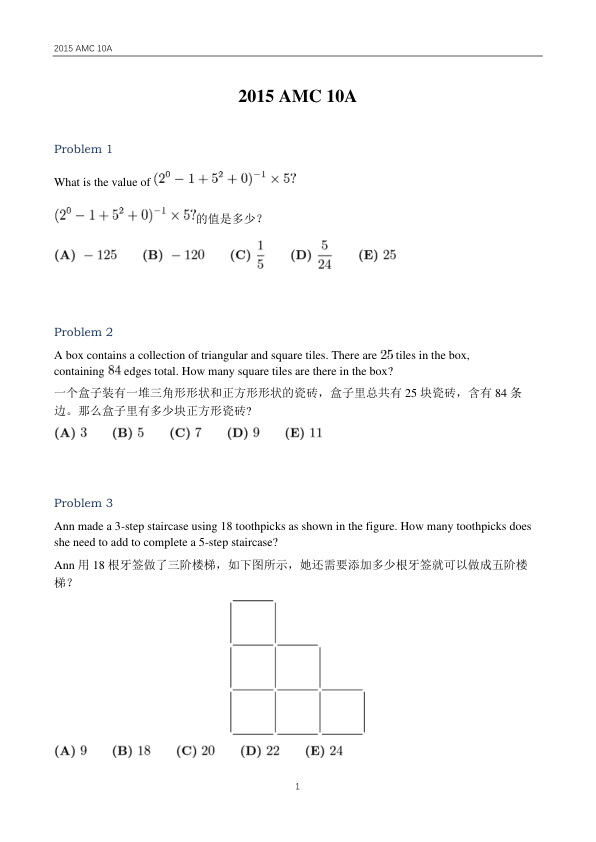
2015 AMC 10A
Problem 1
What is the value of $(2^0 - 1 + 5^2 + 0)^{-1} \times 5$?
$(2^0 - 1 + 5^2 + 0)^{-1} \times 5$ 的值是多少?
(A) $-125$ (B) $-120$ (C) $\frac{1}{5}$ (D) $\frac{5}{24}$ (E) $25$
Problem 2
A box contains a collection of triangular and square tiles. There are 25 tiles in the box, containing 84 edges total. How many square tiles are there in the box?
一个盒子装有一堆三角形形状和正方形形状的瓷砖,盒子里总共有 25 块瓷砖,含有 84 条边。那么盒子里有多少块正方形瓷砖?
(A) $3$ (B) $5$ (C) $7$ (D) $9$ (E) $11$
Problem 3
Ann made a 3-step staircase using 18 toothpicks as shown in the figure. How many toothpicks does she need to add to complete a 5-step staircase?
Ann 用 18 根牙签做了三阶楼梯,如下图所示,她还需要添加多少根牙签就可以做成五阶楼梯?
(A) $9$ (B) $18$ (C) $20$ (D) $22$ (E) $24$
英文真题
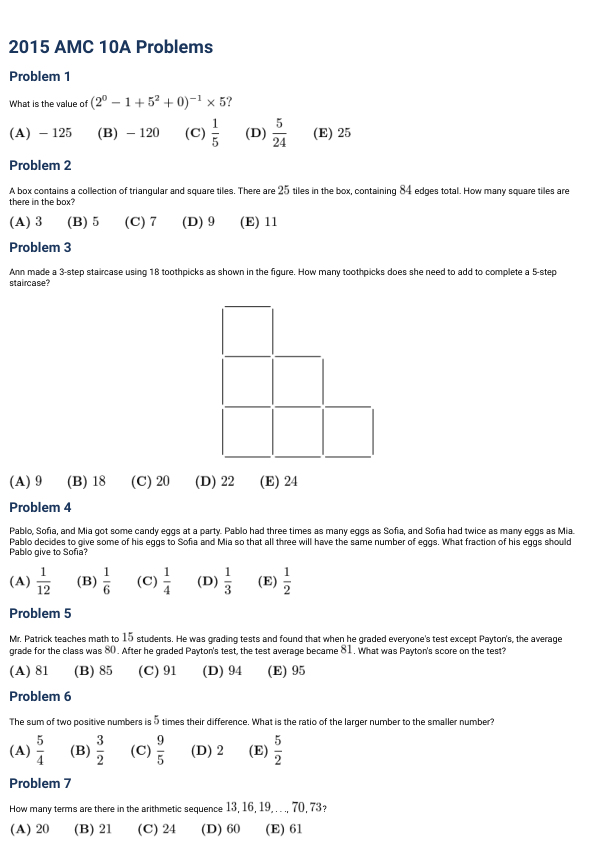
2015 AMC 10A Problems Problem 1 What is the value of $(2^0 - 1 + 5^2 + 0)^{-1} \times 5$?
(A) $-125$ (B) $-120$ (C) $\frac{1}{5}$ (D) $\frac{5}{24}$ (E) $25$
Problem 2 A box contains a collection of triangular and square tiles. There are 25 tiles in the box, containing 84 edges total. How many square tiles are there in the box?
(A) $3$ (B) $5$ (C) $7$ (D) $9$ (E) $11$
Problem 3 Ann made a 3-step staircase using 18 toothpicks as shown in the figure. How many toothpicks does she need to add to complete a 5-step staircase?
(A) $9$ (B) $18$ (C) $20$ (D) $22$ (E) $24$
Problem 4 Pablo, Sofia, and Mia got some candy eggs at a party. Pablo had three times as many eggs as Sofia, and Sofia had twice as many eggs as Mia. Pablo decides to give some of his eggs to Sofia and Mia so that all three will have the same number of eggs. What fraction of his eggs should Pablo give to Sofia?
(A) $\frac{1}{12}$ (B) $\frac{1}{6}$ (C) $\frac{1}{4}$ (D) $\frac{1}{3}$ (E) $\frac{1}{2}$
Problem 5 Mr. Patrick teaches math to 15 students. He was grading tests and found that when he graded everyone's test except Payton's, the average grade for the class was 80. After he graded Payton's test, the test average became 81. What was Payton's score on the test?
(A) $81$ (B) $85$ (C) $91$ (D) $94$ (E) $95$
Problem 6 The sum of two positive numbers is 5 times their difference. What is the ratio of the larger number to the smaller number?
(A) $\frac{5}{4}$ (B) $\frac{3}{2}$ (C) $\frac{9}{5}$ (D) $2$ (E) $\frac{5}{2}$
Problem 7 How many terms are there in the arithmetic sequence 13, 16, 19, ..., 70, 73?
(A) $20$ (B) $21$ (C) $24$ (D) $60$ (E) $61$
真题文字详解(英文)
Problem 1 The following problem is from both the 2015 AMC 12A #7 and 2015 AMC 10A #1, so both problems redirect to this page. What is the value of ((2^0 - 1 + 5^2 - 0)^{-1} \times 5) ?
(A) $-125$ (B)$120$ (C)$\frac{1}{5}$ (D)$\frac{1}{24}$ (E)$25$
Solution
$(2^{0}-1+5^{2}-0)^{-1} \times 5=(1-1+25-0)^{-1} \times 5=25^{-1} \times 5=\left(\mathrm{C} \frac{1}{5}\right)$
Problem 2 A box contains a collection of triangular and square tiles. There are 25 tiles in the box, containing 84 edges total. How many square tiles are there in the box?
(A) 3 (B) 5 (C) 7 (D) 9 (E) 11
Solution Let $a$ be the amount of triangular tiles and $b$ be the amount of square tiles. Triangles have 3 edges and squares have 4 edges, so we have a system of equations. We have $a+b$ ties total, so $a+b=25$. We have $3a+4b$ edges total, so $3a+4b=84$. Multiplying the first equation by 3 on both sides gives $3a+3b=3(25)=75$. Second equation minus the first equation gives $b=9$, so the answer is (D) 9.
Solution 2 If all of the tiles were triangles, there would be $75$ edges. This is not enough, so there needs to be some squares. Trading a triangle for a square results in one additional edge each time, so we must trade out 9 triangles for squares. Answer: (D) 9
Problem 3 Ann made a 3-step staircase using 18 toothpicks as shown in the figure. How many toothpicks does she need to add to complete a 5-step staircase?
(A) 9 (B) 18 (C) 20 (D) 22 (E) 24
Solution We can see that a 1-step staircase requires 4 toothpicks and a 2-step staircase requires 10 toothpicks. Thus, to go from a 1-step to a 2-step staircase, 6 additional toothpicks are needed and to go from a 2-step to a 3-step staircase, 8 additional toothpicks are needed. Applying this pattern, to go from a 3-step to a 4-step staircase, 10 additional toothpicks are needed and to go from a 4-step to a 5-step staircase, 12 additional toothpicks are needed. Our answer is $10+12=$ (D) 22
Solution 2 Alternatively, we can see that the 3-step staircase has $2[2(3)+2+1]=18$ toothpicks. Generalizing, we see that a staircase with $x$ steps has $2[2(x+(x-1)+(x-2)+\ldots+1]$ toothpicks. So for $x=5$ steps, we have $2[2(5)+4+3+2+1]=40$ toothpicks. So our answer is $40-18=22$ or (D) 22
Solution 3 If one is too lazy to derive a formula for the number of picks needed for a given number of steps, one can simply see that to get to 4 steps, we add two blobs that have three picks each (the top and the right), and two more blocks that have two picks each to form the steps. This adds $2 \cdot 3+2 \cdot 2=10$ picks. Then to get to 5 steps, we add two more blobs with 3 picks each and 3 more blobs that have two picks each. We add $2 \cdot 3+3 \cdot 2=12$ more for a total increase of $10+12=$ (D) 22
Problem 4 Pablo, Sofia, and Mia got some candy eggs at a party. Pablo had three times as many eggs as Sofia, and Sofia had twice as many eggs as Mia. Pablo decides to give some of his eggs to Sofia and Mia so that all three will have the same number of eggs. What fraction of his eggs should Pablo give to Sofia?
(A) $\frac{1}{12}$ (B) $\frac{1}{6}$ (C) $\frac{1}{4}$ (D) $\frac{1}{3}$ (E) $\frac{1}{
真题文字详解(中英双语)
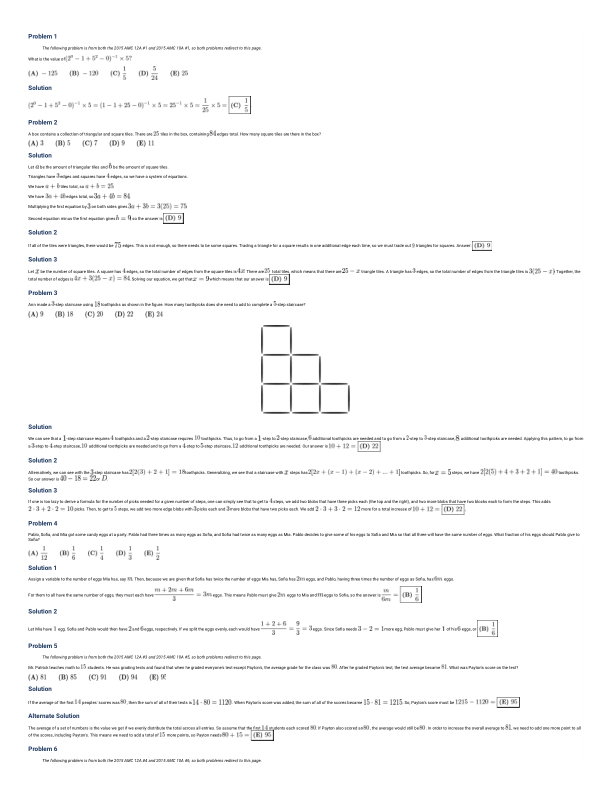
Problem 1
The following problem is from both the 2015 AMC 12A #7 and 2015 AMC 10A #1, so both problems redirect to this page.
What is the value of $(2^0 - 1 + 5^2 - 0)^{-1} \times 5$?
$(2^0 - 1 + 5^2 - 0)^{-1} \times 5$ 的值是多少?
(A) $-125$ (B) $120$ (C) $\frac{1}{5}$ (D) $\frac{5}{24}$ (E) $25$
Solution
$(2^0 - 1 + 5^2 - 0)^{-1} \times 5 = (1 - 1 + 25 - 0)^{-1} \times 5 = 25^{-1} \times 5 = \frac{1}{25} \times 5 = \boxed{\text{(C)}\frac{1}{5}}$
Problem 2
A box contains a collection of triangular and square tiles. There are 25 tiles in the box, containing 84 edges total. How many square tiles are there in the box?
一个盒子里装有一些三角板和正方形瓷砖。盒子中有25块瓷砖,总共有84条边。盒子里有多少块正方形瓷砖?
(A) $3$ (B) $5$ (C) $7$ (D) $9$ (E) $11$
Solution
Let $a$ be the amount of triangular tiles and $b$ be the amount of square tiles.
设$a$为三角形瓷砖的数量,$b$为正方形瓷砖的数量。
Triangles have 3 edges and squares have 4 edges, so we have a system of equations.
三角形有3条边,正方形有4条边,所以我们有一个方程组。
$$ \begin{cases} a + b = 25 \ 3a + 4b = 84 \end{cases} $$
我们一共有$a + b$块瓷砖,所以$a + b = 25$。
我们有$3a + 4b$条边,所以$3a + 4b = 84$。
我们一共有$3a + 4b$条边,所以$3a + 4b = 84$。
Multiplying the first equation by 3 on both sides gives $3a + 3b = 3(25) = 75$.
将第一个方程两边同时乘以3得到$3a + 3b = 3(25) = 75$。
Second equation minus the first equation gives $b = 9$, so the answer is $\boxed{\text{(D)}\ 9}$.
第二个方程减去第一个方程得到$b = 9$,所以答案是$\boxed{\text{(D)}\ 9}$。
Solution 2
If all of the tiles were triangles, there would be $75$ edges. This is not enough, so there needs to be some squares. Trading a triangle for a square results in one additional edge each time, so we must trade out $9$ triangles for squares. Answer: $\boxed{\text{(D)}\ 9}$.
如果所有的瓷砖都是三角形,就会有75条边。这还不够,所以需要一些正方形。用一个三角形换成一个正方形每次会增加一条边,所以我们必须用9个三角形换成正方形。答案:$\boxed{\text{(D)}\ 9}$。
Solution 3
Let $x$ be the number of square tiles. A square has 4 edges, so the total number of edges from the square tiles is $4x$. There are 25 total tiles, which means that there are $25 - x$ triangle tiles. A triangle has 3 edges, so the total number of edges from the triangle tiles is $3(25 - x)$. Together, the total number of edges is $4x + 3(25 - x) = 84$. Solving our equation, we get that $x = 9$ which means that our answer is $\boxed{\text{(D)}\ 9}$.
设$x$为正方形瓷砖的数量。一个正方形有4条边,所以正方形瓷砖的总边数是$4x$。总共有25块瓷砖,这意味着有$25 - x$块三角形瓷砖。一个三角形有3条边,所以三角形瓷砖的总边数是$3(25 - x)$。总共的边数是$4x + 3(25 - x) = 84$。解这个方程,我们得到$x = 9$,这就是我们的答案$\boxed{\text{(D)}\ 9}$。
Problem 3
Ann made a 3-step staircase using 18 toothpicks as shown in the figure. How many toothpicks does